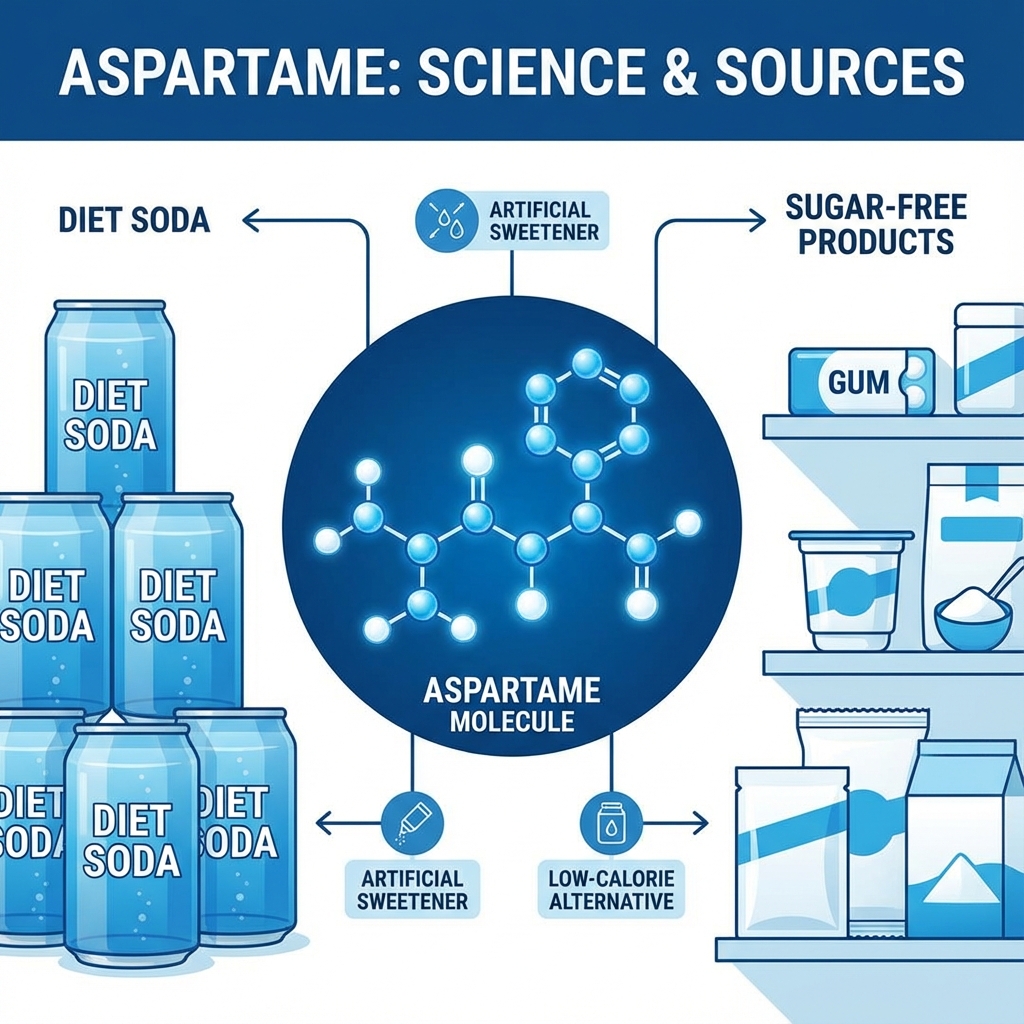
Aspartame is one of the most studied and controversial food additives in history. Found in over 6,000 products worldwide, from diet sodas to sugar-free gum, it has been at the center of health debates for decades. In July 2023, headlines exploded when the WHO classified aspartame as "possibly carcinogenic." But what does this really mean for you?
This comprehensive guide examines the science, separates fact from fear, and helps you make informed decisions about aspartame and your health.
In This Article
- • What is Aspartame?
- • The WHO Classification Explained
- • How Much Aspartame is Safe?
- • Common Side Effects
- • Who Should Avoid Aspartame
- • Healthier Alternatives
- • The Bottom Line
What is Aspartame?
Aspartame is an artificial sweetener discovered in 1965 by chemist James Schlatter. It is approximately 200 times sweeter than sugar, which means very small amounts can provide significant sweetness without adding calories.
Chemically, aspartame is made of two amino acids: aspartic acid and phenylalanine. When you consume aspartame, your body breaks it down into these amino acids plus a small amount of methanol. All three substances occur naturally in many foods you already eat.
Common Products Containing Aspartame
Beverages
- • Diet Coke, Coke Zero
- • Diet Pepsi
- • Crystal Light
- • Sugar-free iced tea
Foods
- • Sugar-free gum
- • Sugar-free yogurt
- • Sugar-free candy
- • Protein bars
Tabletop Sweeteners
- • Equal
- • NutraSweet
- • Canderel
Other Products
- • Some medications
- • Vitamins
- • Cough drops
The WHO Classification: What It Really Means
In July 2023, the International Agency for Research on Cancer (IARC), part of the WHO, classified aspartame as "possibly carcinogenic to humans" (Group 2B). This made headlines worldwide and understandably caused concern. But the full story is more nuanced.
⚠️ Understanding Group 2B Classification
Group 2B means there is "limited evidence" of cancer risk in humans. This is the same category as:
- • Aloe vera (whole leaf extract)
- • Pickled vegetables (traditional Asian)
- • Radiofrequency electromagnetic fields (mobile phones)
- • Caffeic acid (found in coffee)
This classification describes hazard (could it cause cancer under any circumstances) not risk (how likely is it to cause cancer at normal consumption levels).
Importantly, on the exact same day as the IARC announcement, another WHO body called JECFA (Joint FAO/WHO Expert Committee on Food Additives) released their own review. They maintained the existing safe daily intake level, concluding there was no convincing evidence that aspartame is unsafe at typical consumption levels.
In other words: The classification says aspartame might potentially be harmful in some theoretical scenario, but the actual risk assessment says current consumption levels appear to be safe.
How Much Aspartame is Safe?
The Acceptable Daily Intake (ADI) for aspartame, established by regulatory agencies worldwide, is 40 mg per kilogram of body weight. This limit has been maintained for decades and was reaffirmed by JECFA in 2023.
What Does This Mean in Practice?
For a 70 kg (154 lb) person, the daily limit is 2,800 mg of aspartame.
| Product | Aspartame | Daily Limit |
|---|---|---|
| Diet soda (12 oz can) | ~180 mg | ~15 cans |
| Sugar-free gum (1 piece) | ~6-8 mg | ~350 pieces |
| Tabletop sweetener packet | ~35 mg | ~80 packets |
| Sugar-free yogurt | ~100 mg | ~28 servings |
Most people consume far below these levels. Studies show average consumption is typically 5-15% of the ADI.
Common Side Effects and Concerns
While aspartame is approved as safe, some people report experiencing side effects. Here is what the science says about the most common concerns.
Headaches
One of the most frequently reported complaints. Some clinical trials have found a small subset of people who appear genuinely sensitive to aspartame-triggered headaches. However, larger controlled studies have not found aspartame to cause headaches more than placebo.
Recommendation: If you consistently get headaches after consuming aspartame, you may be among those who are sensitive. Consider eliminating it and monitoring your symptoms.
Digestive Issues
Some people report bloating, gas, or diarrhea. This is more commonly associated with sugar alcohols (like sorbitol or maltitol) that often appear alongside aspartame in products.
Recommendation: Check ingredient labels. If a product contains multiple sweeteners, it may be another ingredient causing the issue.
Weight Gain Paradox
Surprisingly, some studies suggest artificial sweeteners may not help with weight loss and could potentially contribute to weight gain. The theories include:
- • Disruption of gut bacteria
- • Altered taste preferences leading to more sweet cravings
- • Psychological compensation (eating more because drink is diet)
- • Effects on insulin response
Recommendation: Artificial sweeteners should not be viewed as a free pass. Reducing overall sweetness in your diet is the best long-term strategy.
Gut Microbiome Effects
Emerging research suggests artificial sweeteners may alter gut bacteria composition. A 2022 study in Cell found that some people's blood sugar responses were affected by artificial sweeteners, potentially through gut microbiome changes.
Recommendation: This research is still developing. If gut health is a priority, limiting all artificial sweeteners may be prudent.
Who Should Definitely Avoid Aspartame
⛔ People with Phenylketonuria (PKU)
This is the only group that absolutely must avoid aspartame. PKU is a rare genetic condition where the body cannot properly process phenylalanine, one of the amino acids in aspartame.
PKU affects about 1 in 10,000-15,000 newborns. If you have PKU, you already know to avoid aspartame. All products containing aspartame must carry a warning label: "Phenylketonurics: Contains Phenylalanine."
Beyond PKU, certain groups may want to be more cautious:
Pregnant Women
While considered safe, some women prefer to minimize artificial additives during pregnancy. Consult your healthcare provider.
Children
The ADI is weight-based, so children reach limits at lower amounts. Water and milk remain the best beverage choices.
People with Chronic Conditions
If you have ongoing health concerns, discuss sweetener choices with your doctor.
Healthier Alternatives to Aspartame
If you want to reduce or eliminate aspartame but still enjoy some sweetness, here are science-backed alternatives ranked from most to least natural:
Stevia
Extracted from the leaves of the Stevia rebaudiana plant. Zero calories, zero blood sugar impact. 200-300 times sweeter than sugar.
Best for: Coffee, tea, baking (with adjustments). Look for pure stevia without additives.
Monk Fruit (Luo Han Guo)
A natural sweetener from a fruit native to Southeast Asia. Zero calories, no blood sugar impact. 150-200 times sweeter than sugar.
Best for: Beverages, desserts, smoothies. Often combined with erythritol for better texture.
Erythritol
A sugar alcohol that occurs naturally in some fruits. About 70% as sweet as sugar with only 0.2 calories per gram. Does not affect blood sugar.
Best for: Baking, where you need bulk. Easier digestive tolerance than other sugar alcohols.
Allulose
A rare sugar found naturally in figs and raisins. Tastes and behaves like sugar but with only 0.4 calories per gram. Minimal blood sugar impact.
Best for: Baking and cooking where you want sugar-like results.
The Real Solution: Reducing Sweetness Overall
Here is the truth that neither the sugar industry nor the artificial sweetener industry wants you to hear: the best approach is to gradually reduce your overall consumption of sweet-tasting foods and drinks.
When you constantly consume sweet substances, whether sugar, aspartame, or even stevia, you maintain a high sweetness threshold. You continue to crave sweet foods. Your taste buds never reset.
Research shows that after 2-4 weeks of reduced sugar consumption, taste sensitivity increases. Foods that once seemed boring become satisfying. Natural sweetness in fruits becomes more pronounced. Cravings decrease.
Track Your Sweetener Intake
The Sukali app helps you identify hidden sugars and artificial sweeteners in your food. Scan any product to see exactly what is in it, track your daily intake, and gradually reduce your dependence on sweet foods.
The Bottom Line
Aspartame is one of the most studied food additives in history. At normal consumption levels, major regulatory agencies consider it safe. The WHO's 2023 classification as "possibly carcinogenic" was a hazard assessment, not a finding that typical consumption causes cancer.
That said, science is evolving. New research on gut microbiome effects and metabolic impacts is emerging. If you are concerned about aspartame, there are natural alternatives like stevia and monk fruit that may offer acceptable sweetness with fewer uncertainties.
The wisest long-term strategy is not to find the perfect sugar substitute but to gradually reduce your overall consumption of sweet foods. Your taste buds will adapt, your cravings will diminish, and your health will benefit.
Frequently Asked Questions
Is aspartame safe to consume?
Regulatory agencies including the FDA and EFSA consider aspartame safe at current consumption levels. The ADI is 40mg per kg of body weight. For a 70kg person, this equals about 14 cans of diet soda daily, far more than most people consume.
Did the WHO say aspartame causes cancer?
In July 2023, IARC classified aspartame as "possibly carcinogenic to humans" (Group 2B). This indicates limited evidence and describes potential hazard, not actual risk at normal consumption. Notably, JECFA simultaneously reaffirmed the safe daily intake level.
What are the most common side effects?
Some people report headaches, dizziness, and digestive issues. People with phenylketonuria (PKU) must avoid aspartame as they cannot metabolize phenylalanine. Scientific evidence for other reported effects remains inconclusive in controlled studies.
What are healthier alternatives?
Natural alternatives include stevia (from plant leaves), monk fruit (zero calories, no blood sugar impact), and erythritol (sugar alcohol with minimal calories). The healthiest approach is gradually reducing overall sweetener consumption.
Ready to Quit Sugar & Artificial Sweeteners?
Download Sukali to scan foods for hidden sugars and sweeteners, track your intake, and get personalized guidance on your journey to better health.