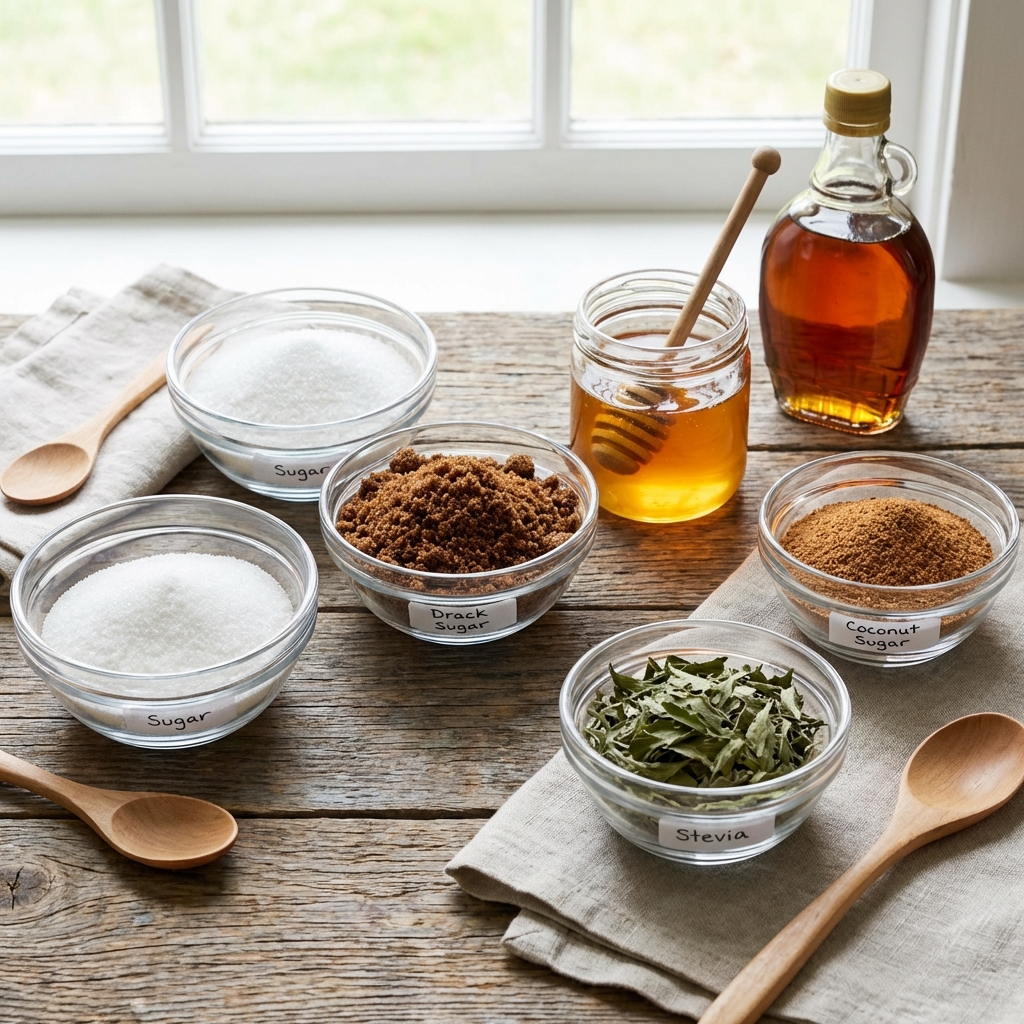
Walk down the sugar aisle and you will find dozens of options: white sugar, brown sugar, raw sugar, coconut sugar, honey, maple syrup, agave nectar. Each one claims to be healthier or more natural than the others.
But here is what the marketing does not tell you: to your body, most of these are essentially the same thing. Let me break down the different types of sugar so you can make informed choices.
The Basic Science
Before we dive into specific types, you need to understand the building blocks. All sugars are made up of simple sugar molecules, and there are only a few that matter:
Glucose is the sugar your body uses for energy. Every cell in your body can use it. When you eat carbohydrates, they are eventually broken down into glucose.
Fructose is found in fruits and honey. Unlike glucose, only your liver can process fructose. Too much of it gets converted to fat.
Sucrose is table sugar. It is made of one glucose molecule and one fructose molecule stuck together. When you eat it, your body splits it into its two parts.
White Sugar (Table Sugar)
White sugar is pure sucrose, extracted from sugar cane or sugar beets and refined to remove everything except the sugar itself. It is the standard against which other sugars are measured.
It contains no vitamins, no minerals, no fiber, nothing but calories. This is why it is often called "empty calories." Your body breaks it down into glucose and fructose almost immediately.
Brown Sugar
Here is a surprise: brown sugar is just white sugar with molasses added back in. That is it. The molasses gives it the brown color and slightly different taste.
Does the molasses add any nutritional value? Technically yes, there are trace amounts of minerals. But the amounts are so small they are nutritionally irrelevant. You would have to eat cups of brown sugar to get any meaningful nutrients.
From your body's perspective, brown sugar is essentially identical to white sugar.
Raw Sugar and Turbinado
Raw sugar sounds healthier because it is less processed. It still has some of the natural molasses coating on the crystals, giving it that brownish color and slight caramel taste.
But make no mistake: raw sugar is still about 96-99% sucrose. The difference from white sugar is negligible. Your body processes it exactly the same way.
Coconut Sugar
Coconut sugar has become trendy in health circles. It is made from the sap of coconut palm trees and is less processed than refined sugar.
The main claim is that it has a lower glycemic index, meaning it raises blood sugar more slowly. This is partially true, but the difference is modest. It still contains about 75% sucrose and will still affect your blood sugar.
It does contain small amounts of nutrients like zinc, iron, and potassium, but again, the amounts are too small to matter unless you are eating ridiculous quantities.
Honey
Honey is often seen as the "natural" alternative to sugar. And it is natural, bees make it from flower nectar. But natural does not mean healthy in unlimited quantities.
Honey is about 40% fructose and 30% glucose, plus some water and trace nutrients. It actually has slightly more calories per teaspoon than white sugar because it is denser.
Raw honey does contain antioxidants and has some antibacterial properties. But these benefits are largely destroyed if you heat it. And the sugar content means it still affects your body like sugar does.
Maple Syrup
Real maple syrup (not the corn syrup stuff) comes from the sap of maple trees. It contains some minerals like manganese and zinc, more than most other sugars.
But it is still about 60% sucrose. One tablespoon has about 12 grams of sugar. It is a slightly better choice than refined sugar, but it is still sugar and should be limited.
Agave Nectar
Agave was marketed as a healthy alternative because it has a low glycemic index. But here is the catch: it has a low glycemic index because it is extremely high in fructose, sometimes up to 90%.
Remember, fructose can only be processed by your liver. High fructose intake is linked to fatty liver disease, insulin resistance, and belly fat. Agave might actually be worse for you than regular sugar.
Check Sugar in Any Food
No matter which type of sugar a product uses, what matters is how much. The Sukali app scans any food and shows you the total sugar content instantly.
Download FreeHigh Fructose Corn Syrup
HFCS is made from corn and is the most common sweetener in processed foods and sodas, at least in the United States. It is cheap to produce, which is why it is everywhere.
The most common form is HFCS-55, which is 55% fructose and 45% glucose. That is pretty similar to table sugar. The debate about whether it is worse than sugar continues, but the bottom line is that they are both bad in excess.
The real problem with HFCS is not that it is inherently more harmful than sugar, but that it is in everything. It shows up in bread, ketchup, salad dressing, and products you would never expect. This makes it easy to overconsume without realizing.
Natural Sugars in Whole Foods
Now here is where things get different. The sugar naturally present in whole fruits and vegetables is not the same as added sugar, even though they are chemically similar.
When you eat an apple, you get sugar, but you also get fiber, water, and nutrients. The fiber slows down sugar absorption so you do not get the same blood sugar spike. You also feel full faster.
This is why health guidelines focus on limiting added sugars, not natural sugars in whole foods. The delivery system matters.
The Bottom Line
Here is the uncomfortable truth: most "natural" or "healthier" sugars are not much better than white sugar. Your body processes them in largely the same way.
If you had to rank them from best to worst:
Best: Whole fruits (natural sugar with fiber)
Slightly better: Raw honey, maple syrup (have some nutrients)
About the same: White sugar, brown sugar, coconut sugar, raw sugar
Potentially worse: Agave nectar, high fructose corn syrup (high fructose content)
The real solution is not finding a "healthier" sugar. It is reducing your overall sugar intake, regardless of the source. Sugar is sugar.
Reduce All Types of Sugar
Download Sukali to scan foods and track your sugar intake. Get 100+ sugar-free recipes to help you cut back.